Built in Ontario, for Canadian practices
Ontario OHIP validation for any system you run
Check a patient's health card against the Ministry of Health's HCV system in real time — one HTTPS request, JSON in and JSON out. Built to drop into EMRs, health applications, billing software, booking systems and in-house tools, without a SOAP integration or a conformance project. $49 CAD a month, hosted in Canada.
- $49 CAD/mo · per account
- Under a second · typical response
- Toronto · where the data lives
Built to integrate with
- EMR systems
- Health applications
- Billing software
- Booking & scheduling
- Patient intake tools
- In-house builds
A plain HTTPS POST with JSON — no SDK, no client certificate, no SOAP stack. If it can make an HTTP request, it can validate a health card.
Not a developer? Validate in your browser.
You don't need an API or an integration to check a health card. Type the number, press validate, read the ministry's answer — in about a second, at the front desk. Free if you're a solo physician.
Validate a card online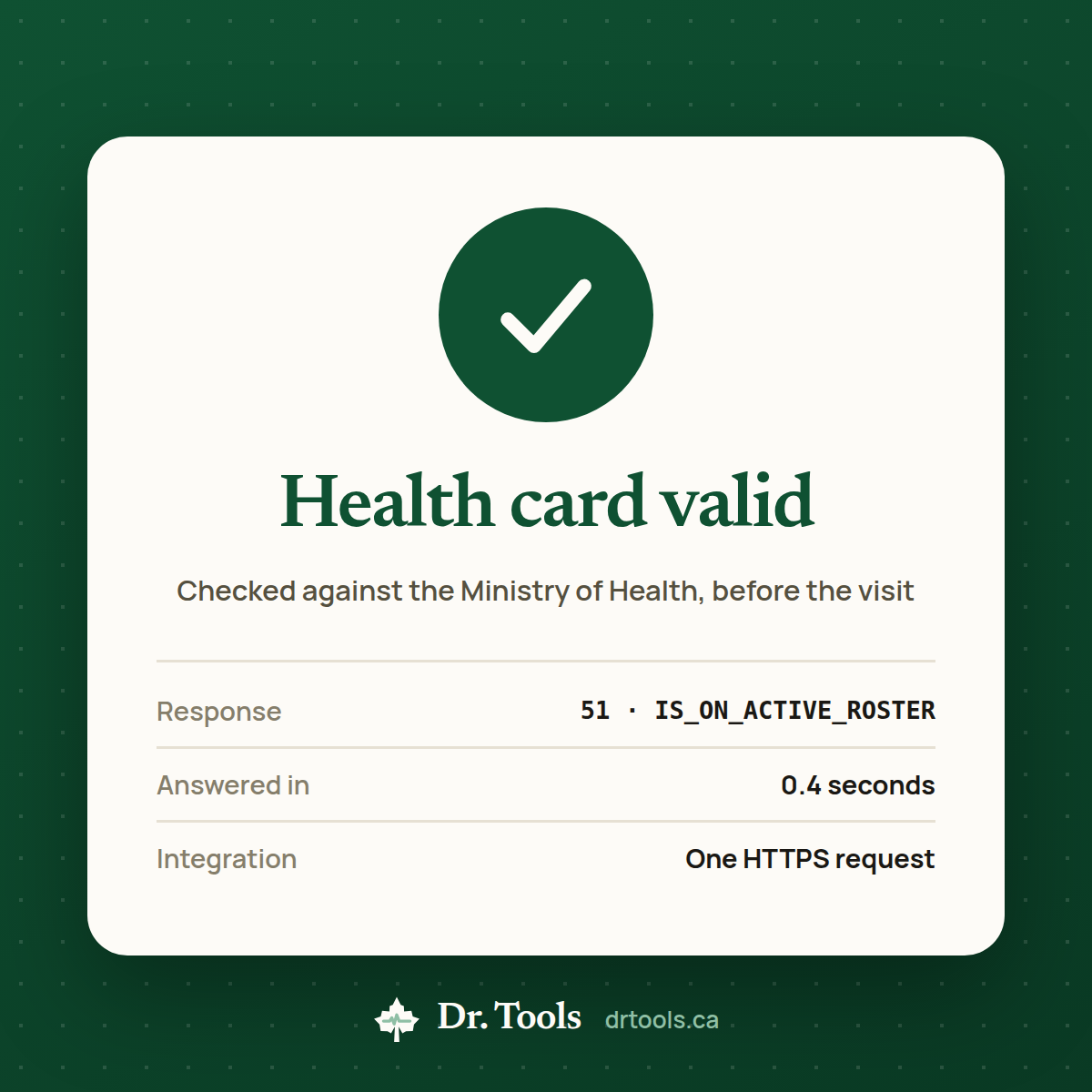
Why Dr. Tools
Ontario MOH integrated
Direct connections to ministry health card validation and claims transfer — the plumbing done once, by us.
Data stays in Canada
Processing and storage in Canadian data centres. No cross-border transfer in ordinary operation.
AI where it earns its place
Drafting notes and filling forms — the repetitive work. Every output is reviewed and signed by a clinician.
Prices you can read
$49 a month for the Validation API, published on the page. The rejection report is free. No quote-only mystery.
Our products
Validation is where most
people arrive. It isn't all we build.
Six tools for Canadian practices and the software that serves them. The OHIP-facing ones are built specifically for Ontario; the clinical tools are not province-bound. Each works on its own.
PocketEMR
The whole practice, in one clean interface
A complete EMR for Ontario specialists — patient charts, OHIP billing, e-prescribing with pharmacy fax, AI voice notes, a virtual fax centre and scheduling.
Learn moreOHIP Validation API
Ontario health card validation in one HTTP request
A real-time REST/JSON service that checks a health card against the Ministry of Health's HCV system — instead of a SOAP integration and a conformance project.
Learn moreMOH Rejection Correction Report
Find out why every claim was rejected — free
Upload a Ministry of Health rejection file and get a plain-English report: what each error code means, which claims are fixable, and what to change before you resubmit. Free service.
Learn moreAI Transcriber
Talk through the visit. Get the note.
GPU-accelerated clinical transcription with speaker diarization and automatic SOAP note generation, running on hardware you control.
Learn moreFormsMD
Any medical PDF, filled from the chart
Point it at a lab requisition, insurance form or referral and it maps the fields, pulls the patient data and fills the PDF — with optional PHI de-identification.
Learn moreMCEDT / EDT Integration
Claim files up, remittance and error reports down
Programmatic Medical Claims Electronic Data Transfer — submit claim batches to the ministry and pull back remittance advice and error reports on the same account as the Validation API.
Learn moreCanadian data residency
Servers, databases and backups run in Canadian data centres — validation processing happens in Toronto. Patient data is not transferred outside Canada in the ordinary operation of our services, and no foreign jurisdiction has routine access to it.
Built for PHIPA obligations
Encryption in transit and at rest, role-based access, comprehensive audit logging, and health card numbers hashed rather than stored in the clear. Concrete controls, described plainly — because compliance is a determination your organisation makes, not a badge a vendor hands you.
Resilience by design
A live standby database in a second location under continuous streaming replication, tested failover, daily encrypted backups, and continuous uptime monitoring. We describe the architecture rather than publishing an uptime percentage we would not stand behind contractually.
What's next
Always shipping
On the roadmap, not yet available. Listed so you know where this is going.
AI Referral Writer
Draft specialist referral letters straight from the clinical note.
Secure Document Exchange
Encrypted document sharing between clinics and specialists.
Patient Portal
Self-service booking, intake forms and secure messaging.
About Dr. Tools
OHIP validation, and the rest of the stack
Dr. Tools is an independent Canadian software company based in Kitchener, Ontario. We are not affiliated with, endorsed by or certified by the Ontario Ministry of Health.
Request a demoOntario OHIP validation
The OHIP Validation API connects to the Ministry of Health's Health Card Validation (HCV) system so that a health number and version code can be checked in real time — typically in under a second — before a service is rendered. It replaces a SOAP integration with client certificates, WS-Security and a mandatory conformance process with a single HTTPS request carrying an API key header.
Because it is a plain REST/JSON service, it is built to integrate with whatever a practice already runs: EMR systems, health applications, billing software, booking and scheduling tools, patient intake workflows and in-house builds. There is no SDK to adopt and no certificate store to maintain. Batch validation lets many cards be checked in one call, which is how billing agencies and multi-provider clinics use it. If you are trying to understand a specific result, the OHIP response code reference explains every code band the ministry returns.
Validation is one half of the OHIP billing cycle. The MCEDT/EDT integration handles the other half — submitting claim files to the ministry and retrieving remittance advice and error reports — and when claims do come back rejected, the MOH Rejection Correction Report decodes the ministry's error codes, groups rejections by underlying cause and identifies which claims are still recoverable. That one is free and does not require an account.
What else we build
Dr. Tools also develops electronic medical records, clinical transcription and AI-assisted form completion for Canadian healthcare professionals. The work is focused on Ontario, because the systems that matter here — HCV, OHIP claim submission, Medical Claims Electronic Data Transfer — are provincial infrastructure, and integrating with them properly is not something you do generically.
Our users are specialist physicians and the practices around them: dermatology, cardiology, internal medicine, rheumatology, gastroenterology, endocrinology, nephrology, neurology, psychiatry and surgery, along with the billing agencies and software vendors who serve them.
Clinical documentation
AI Transcriber provides GPU-accelerated medical speech recognition with speaker diarization, so the transcript distinguishes clinician from patient, and assembles a SOAP note draft with clinical entities extracted. It is designed to run on self-hosted hardware, keeping patient audio inside the practice network. FormsMD automates the completion of lab requisitions, insurance claim forms, disability applications, referral letters and government forms from chart data, with optional PHI de-identification. In both cases the output is a draft for a qualified clinician to review and sign.
The practice itself
PocketEMR is a web-based electronic medical record with patient management, e-prescribing with pharmacy fax delivery, clinical notes with AI voice transcription, a virtual fax centre, appointment scheduling and integrated OHIP billing. The other tools are built into it, so validation happens at intake and rejected claims come back decoded inside the system that produced them.
Where your data lives
All Dr. Tools infrastructure runs within Canadian data centres. Patient data is processed and stored in Canada and is not transferred outside the country in the ordinary operation of our services. Controls include encryption in transit and at rest, API keys hashed with Argon2id, health card numbers HMAC-hashed in audit logs, role-based access, two-factor authentication on administrative accounts, and separate validation, security and administrative audit logs. These are built for the obligations Ontario healthcare providers carry under the Personal Health Information Protection Act (PHIPA) and Canada's federal privacy legislation (PIPEDA). No external body has audited or certified them, and we will not imply otherwise.
FAQ
Common questions
What is the Dr. Tools OHIP Validation API?
A real-time REST/JSON service that checks an Ontario health card against the Ministry of Health's Health Card Validation (HCV) system before a service is rendered. You send a health number and version code over HTTPS with an API key header, and you get back the ministry's eligibility answer — typically in under a second — including the official response code, the cardholder's registered demographics and a plain valid/eligible verdict your code can branch on.
What can I integrate OHIP validation with?
Anything that can make an HTTPS request. It is a plain POST with JSON in and JSON out, so EMRs, health applications, billing software, booking and scheduling systems, patient intake tools and in-house builds can all use it — no SDK, no client certificate, no SOAP stack. We supply ready-to-paste examples in cURL, Node.js, Python and Ruby, and an OpenAPI schema is available for generating a client in anything else.
How much does the OHIP Validation API cost?
$49 CAD per month, per account. We set the account up with you and it activates immediately. Billing is monthly and recurring from the activation date, and cancelling stops the next renewal while service continues to the end of the period you have paid for.
Do I need my own Ministry of Health credentials?
Yes — you use your existing Ministry of Health EBS credentials with the validation service and with the MCEDT/EDT integration. Obtaining them is a ministry process on your side and can take time. Activation on our side is immediate once you have them.
What else does Dr. Tools build?
Alongside OHIP validation: a free MOH Rejection Correction Report, an MCEDT/EDT integration for submitting claim files and retrieving remittance, PocketEMR (a full electronic medical record with validation built into intake), AI Transcriber for clinical transcription and SOAP notes, and FormsMD for automatic medical form filling. Each works on its own; they are not a bundle you have to buy into.
Is the MOH Rejection Correction Report really free?
Yes. Upload a Ministry of Health rejection file and the report — decoded error codes, grouped causes and suggested corrections — costs nothing. It exists because rejected claims are the clearest signal of what a practice could be doing differently, and we would rather show you that than charge for it.
Does patient data stay in Canada?
Yes. Processing and storage happen in a Toronto data centre. Patient data is not transferred outside Canada in the ordinary operation of the service, and health card numbers are HMAC-hashed in audit logs rather than stored in the clear.
Do I have to replace my EMR to use any of this?
No. Validation, the rejection correction report and the MCEDT/EDT integration all sit alongside whatever you run today — they are services your existing software calls or files you send us, not a system you migrate onto. FormsMD and AI Transcriber can hand their output back to a connected system. PocketEMR exists for practices that do want to replace the whole stack, but nothing else on this list depends on it.
Is Dr. Tools available outside Ontario?
It depends which product. The OHIP-facing ones — health card validation, MCEDT/EDT claims transfer, the rejection correction report and PocketEMR's billing — integrate directly with Ontario Ministry of Health systems, so they are Ontario-specific by construction. AI Transcriber and FormsMD are not: clinical transcription and form filling do not depend on a provincial billing system. Ontario is where our customers are today. If you are a practice elsewhere in Canada, tell us what you need and we will be straight with you about what works now and what does not.
Where is Dr. Tools based?
Kitchener, Ontario — 151 Charles St W, Suite 100. The software is designed, developed and hosted in Canada.
Ready to reclaim
your time?
We're onboarding Ontario practices now. Tell us what your clinic day looks like and we'll show you where this actually helps — or tell you if it doesn't.
Or email support@drtools.ca — a person reads it.